First Energy Wins Two National Awards for Building-Integrated Solar — and What BIPV Means for Your Building
Home | News & Media

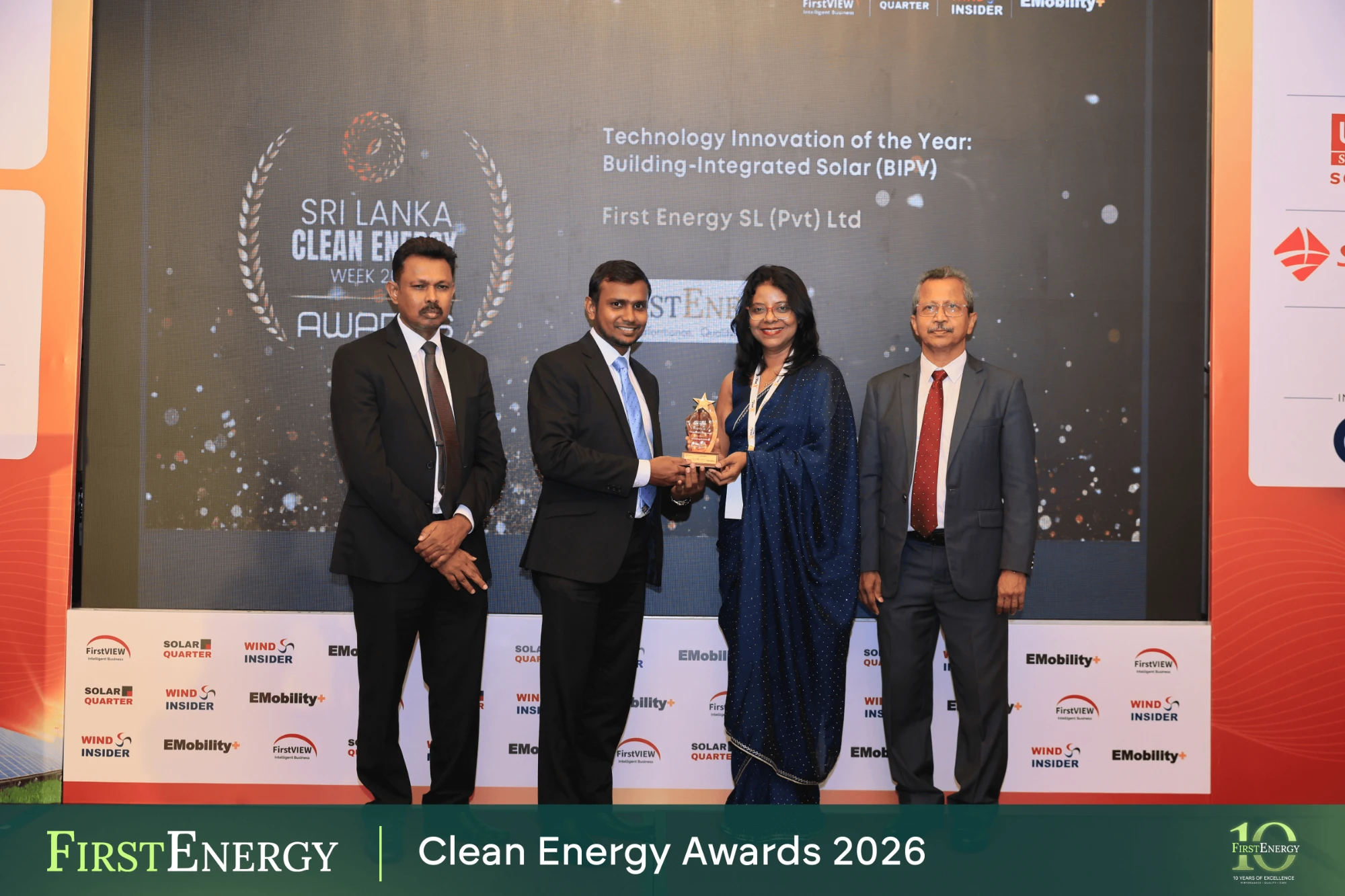
First Energy SL (Pvt) Ltd has won two national awards for building-integrated solar. At the Sri Lanka Clean Energy Week Awards on 21 August 2026, held at Hotel Marino Colombo and organised by FirstVIEW, the company received Project of the Year — Building-Integrated Solar (BIPV) and Technology Innovation of the Year — Building-Integrated Solar (BIPV).
We are glad to have them. But an award is only interesting if it points at something useful, and this one does. Building-integrated photovoltaics — BIPV — is still a niche in Sri Lanka, and most people specifying a commercial building have never been shown a proper costing for it. That is the gap worth writing about.
Here is what BIPV actually is, when it makes financial sense, and when it does not.
The distinction that changes the arithmetic
Conventional rooftop solar is mounted onto a finished building. The roof is already there, already paid for, already doing its job of keeping the rain out. The array sits on top of it on a rail system.
Building-integrated solar is the building element. The photovoltaic module is the facade panel, the skylight, the canopy, the roof sheet. Remove it and you have a hole, not just a missing array.
That single difference moves the entire financial comparison. A rooftop array is judged against the electricity it generates, because it added no other value to the building. A BIPV facade is judged against the electricity it generates plus the cladding it replaced — the aluminium composite panel, the curtain wall glazing, the metal roof sheet that is now not needed and not bought.
That is not a marketing framing. It is a line item. If a facade system was going to cost you a certain amount per square metre regardless, the honest question is not "what does the solar cost?" but "what does the solar cost over and above the material it displaced?"
Why it matters more in Sri Lanka than most places
Two constraints push in the same direction here.
Roof area runs out fast on multi-storey buildings. A single-storey factory has enormous roof relative to its load. An eight-storey office block has the same roof footprint and eight times the consumption. Rooftop solar on a tall commercial building typically covers a small fraction of its demand, and there is no more roof to find.
Facades, meanwhile, are large and mostly unused. A tall building has far more vertical surface than horizontal. Vertical surfaces do produce less per square metre than an optimally tilted array — that is real and it should never be glossed over. But a large mediocre surface can out-produce a small excellent one, and on a tall building the vertical surface is the only surface left.
There is a second effect worth knowing. Vertical east and west facades produce their peak in the morning and late afternoon, not at solar noon. That is a flatter, longer generation curve than a rooftop array gives you, and it lines up better with an office building's occupied hours. For a building trying to consume its own generation rather than export it, curve shape matters as much as total output.
The one moment when BIPV is affordable
BIPV is a new-construction and major-refurbishment decision. It is very rarely a retrofit.
The reason is the displaced-material argument above. If your facade is already built and paid for, BIPV has nothing to displace — you would be stripping good cladding to install solar cladding, and you pay for both. The economics collapse.
If the building is at design stage, or the facade is being replaced anyway, the comparison is favourable and sometimes decisively so. Which means the decision has to be made by the architect and the client at design stage, not by a facilities manager three years after handover. By then the cheap version of the option is gone.
If you are commissioning a commercial building in Sri Lanka in the next two years, this is the point in the project where the question has to be asked. Not later.
What it does not do
We would rather set the limits out plainly than have a client find them later.
- It does not beat a well-oriented rooftop array on cost per unit generated. If you have plenty of unshaded roof, use the roof. BIPV answers the case where you do not.
- It does not suit every facade orientation. North-facing vertical surfaces in Sri Lanka's latitude receive comparatively little direct sun. A facade study, not an assumption, decides which elevations are worth doing.
- Shading from neighbouring buildings is a serious constraint in dense Colombo commercial areas, and it changes through the day and the year. This has to be modelled, not eyeballed.
- Lead times are longer. Integrated modules are a building product on a construction programme, not a stock item off a warehouse shelf. That has to sit in the project schedule from the start.
- It requires the solar contractor and the facade contractor to work as one team. Where those are separate parties with separate contracts and separate programmes, the interface is where things go wrong.
The regulatory position is the same
BIPV is treated no differently from any other rooftop generation under Sri Lanka's connection schemes. The same three routes apply — Net Metering, Net Accounting and Net Plus — and the same export rates.
Under the schedule effective 25 August 2026, a system in the 40–250 kW band is paid Rs. 17.11 per exported unit, and 250 kW to 1 MW is paid Rs. 15.81. A unit consumed on site during the day band displaces roughly Rs. 39.00 on an industrial supply. That ratio is the whole argument for sizing to your own consumption, and it applies to a facade exactly as it applies to a roof.
One further point, because most coverage of the August decision has it wrong: the battery feed-in rate applies only above 250 kW. Below that threshold there is no storage export rate at all — though the Commission's decision says the smaller bands will be considered at the next review. For a commercial building considering BIPV with storage, that threshold decides which case you are even allowed to build.
The 25 August schedule is valid until 24 February 2027, and your rate fixes for twenty years at the point you sign. For a building at design stage, that is not a small detail — it means the connection timing is worth planning alongside the construction programme.
What the award actually signals
The awards were presented at Sri Lanka Clean Energy Week 2026 — the industry's annual gathering of regulators, investors, developers and contractors.
That matters more than the trophies. BIPV becomes normal practice in a market when regulators, investors and builders move together, not when one contractor does good work. Recognition in front of that particular group suggests the category is being taken seriously by the people who decide whether it can scale here.
Ten years in, we are still more interested in putting solar into buildings than onto them.
If you are designing a building now
The BIPV conversation is worth having at design stage and is nearly pointless afterwards. If you have a commercial project on the board — or a facade due for replacement — get in touch for a feasibility study. It will tell you what the integrated option costs net of the material it replaces, which is the only number that settles it.
Sources: Sri Lanka Clean Energy Week 2026 Awards, 21 August 2026, Hotel Marino Colombo, organised by FirstVIEW — award names as confirmed by First Energy · Table 6, page 8, PUCSL Full Final Decision on Feed in Tariffs, effective 25 August 2026, valid to 24 February 2027 · PUCSL Decision on Electricity Tariffs, May 2026 · PUCSL Rooftop Solar PV Connection Schemes.